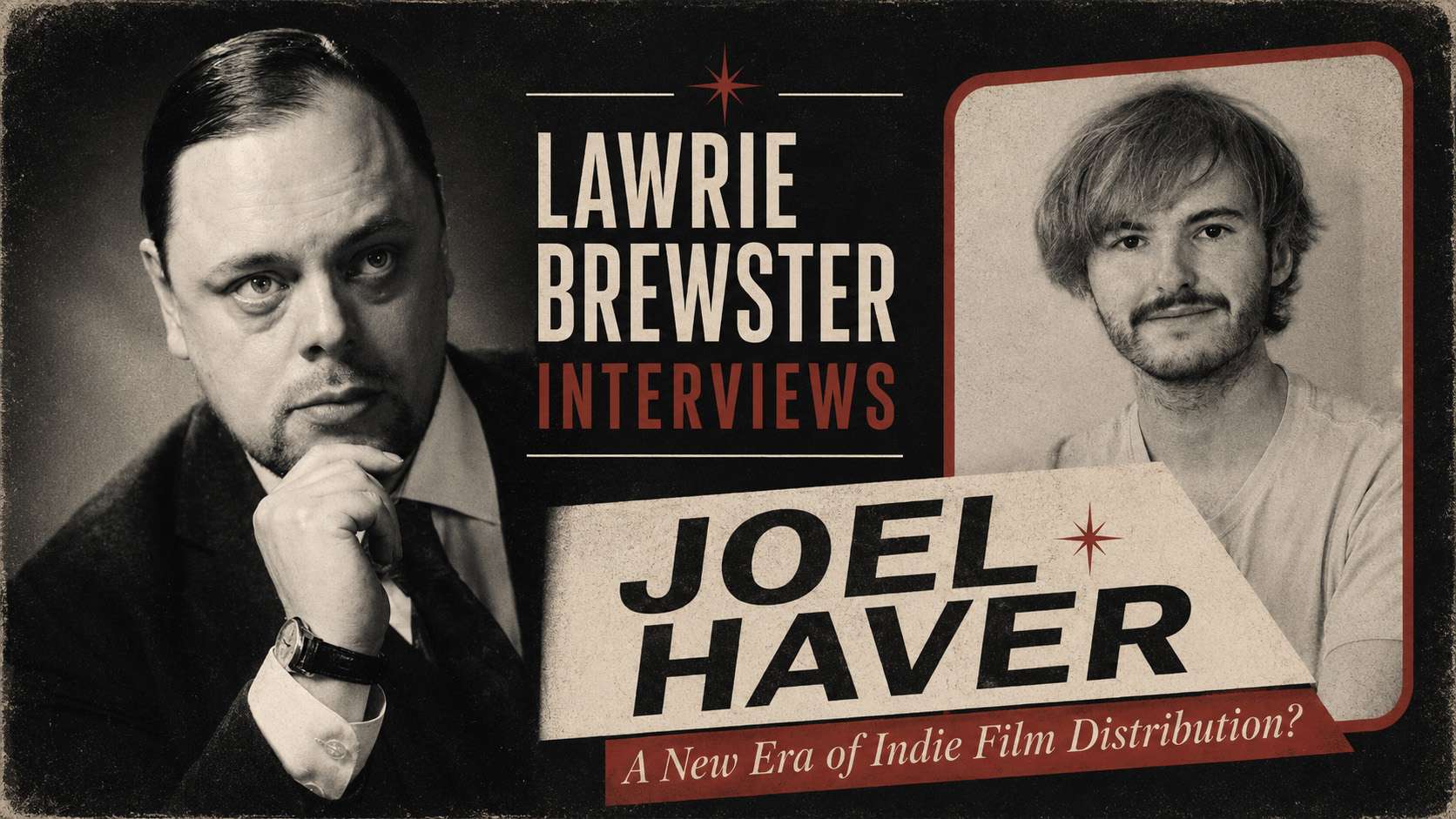
In a new interview with Lawrie Brewster, filmmaker and animator Joel Haver discusses creative freedom, film festivals, independent distribution and why YouTube deserves to be taken seriously as a home for cinema.
Some filmmakers spend years waiting for permission.
Permission from a producer, a financier, a distributor, a film festival, or some distant executive who may never understand what made their work interesting in the first place.
Joel Haver chose another path. He simply began making films, releasing them freely and building a vast audience without waiting for the traditional film industry to declare him legitimate.
That sounds simple, but its implications are rather revolutionary.
Who Is Joel Haver?
Joel Haver is a Canadian-born filmmaker, animator, writer and performer who grew up in Massachusetts before studying filmmaking at the Pratt Institute in New York. He graduated in 2018 and has since developed one of the most distinctive bodies of work to emerge from YouTube, attracting more than two million subscribers while releasing hundreds of short films and numerous feature-length productions.
Many viewers first discovered Joel through his animated comedy shorts. His technique combines live-action performances with loose rotoscoped animation, creating characters who move with an oddly human awkwardness while inhabiting worlds of video game logic, social embarrassment and surreal existential comedy.
Among his most popular films are Playing an RPG for the First Time, Tailing Missions from the NPC’s Perspective, Scooby-Doo but This Happens Instead, The Giant, The Bounty Hunter and Galactic Emperor. Several have attracted millions of views, while his visual style has become so recognisable that it has inspired an entire generation of online animators.
The popularity of those shorts could easily have imprisoned Joel within a successful formula. It would have been perfectly understandable for him to continue producing animated sketches indefinitely, allowing the algorithm to dictate the direction of his career.
Instead, he kept experimenting.
Beyond the Animated Shorts
Joel’s work extends far beyond animation. His films move between improvised comedy, personal documentary, absurdism, melancholy and moments of painful emotional honesty.
Recurring collaborators such as Trent Lenkarski, Alex Martens, Caleb Johnston and Dax Flame have helped create the sense of a genuine artistic community around his work. These are not performers temporarily hired to populate a product. They feel like friends exploring ideas together, often discovering the film as they make it.
His earlier features include Island, Pretend That You Love Me, Drowning in Potential, We Have to Leave Here Together and Things Could Always Be Worse. They are intimate, inexpensive and occasionally rough around the edges, but that roughness often becomes part of their humanity.
Joel has also brought his particular sensibility to television and other media. He voiced and animated Doug in the Smiling Friends episode Brother’s Egg, appeared as Officer Neil in his segment Rightbehindyouton for Hulu’s The Paloni Show! Halloween Special!, and contributed as a director, actor and animator to Adult Swim’s surreal anthology series Off the Air.
These appearances demonstrate that Joel is entirely capable of working within established productions. What makes him interesting is that mainstream recognition has never persuaded him to abandon the independence that allowed him to develop his voice. Even when he was offered a lot of cash to do so!
In fact, he has even spoken publicly about turning down a proposed television series rather than surrendering the freedom he already possessed as an independent artist.
Twelve Feature Films in Twelve Months
In 2024, Joel undertook his most ambitious experiment.
He made and released twelve feature films in twelve months.
The resulting collection included The Hero’s Journey aka My Life aka The Caleb Johnston Story (I’m Caleb), Anyone Else But Me, The Text, Hello My Beautiful Creatures, It Just Takes Time, Hiccups, The Diarrhea Brothers Save the Day, Love, Celeste, The 9th Movie, A Little Film About Friendship, You’re Point Girl and Coming Home.
It would be tempting to regard the project merely as a feat of endurance. Yet the films are not simply twelve versions of the same production.
Some are comic. Others are deeply personal. A Little Film About Friendship follows Joel and Trent Lenkarski spending time together and discussing their lives. Coming Home is a tender documentary centred upon Joel’s mother and the place where he was born. It Just Takes Time explores friendship, grief and the things people struggle to say directly. The Diarrhea Brothers Save the Day, as its splendid title suggests, travels in an entirely different direction.
Why I Wanted to Interview Joel Haver
My interview with Joel was published on 20 July 2026 as the second instalment of my new long-form series, Lawrie Brewster Interviews.
Although Joel and I make very different kinds of films, I recognised something of a kindred spirit in his outlook.
His cinema is often contemporary, improvised, comic and deliberately unpolished. My own work is rooted in Gothic horror, classical filmmaking, romantic imagery and the traditions of studios such as Hammer and Amicus.
Yet beneath those differences is a shared conviction.
Neither of us believes that filmmakers should spend their lives waiting for an established industry or institution to grant them permission to become artists.
At the British Horror Studio, we are attempting to build our own system of production, audience development and distribution. Joel has achieved something similar through YouTube, creating a direct relationship with an audience that allows him to achieve something very real, and in my opinion very sacred.
During our conversation, we discussed the future of independent film distribution, the value and limitations of film festivals, maintaining ownership of one’s work, building an audience outside traditional industry structures and the possibilities offered by releasing feature films directly through YouTube.
We also examined a cultural problem that is perhaps more difficult to overcome than any technical or financial obstacle.
Why is a film shown in a prestigious cinema automatically perceived as more legitimate than one watched freely online?
Why should selection by a festival programmer matter more than the enthusiasm of thousands of viewers?
Why do filmmakers continue surrendering control of their work to distributors, sometimes for very little money, simply because conventional wisdom insists that this is how a proper film career must proceed?
A film does not become less meaningful because it premieres on YouTube. An audience member watching at home is not less real than one sitting inside an approved venue. An artist does not require a distributor, award or institutional blessing to justify the years they have devoted to their craft.
An Independent Filmmaker in the Truest Sense
Joel Haver matters because he has transformed those ideas into a sustainable creative practice.
He has built an audience without allowing that audience to trap him. He has achieved enormous success with short-form animation while continuing to make strange, personal and often defiantly uncommercial feature films. He has collaborated with mainstream productions without allowing mainstream approval to become his destination.
Most importantly, he keeps making things.
That may be the most valuable lesson of all.
Independent filmmaking should not merely describe the budget of a production. It should describe a way of thinking, a willingness to create without permission and a determination to protect the peculiar qualities that make an artist’s work their own.
Joel and I may approach cinema from very different directions, but we share a belief that filmmakers possess far more power than they are often encouraged to recognise.
The technology exists. The platforms exist. The audiences exist.
What remains is for artists to stop waiting for somebody else to tell them that their work is legitimate.
About Lawrie Brewster
Lawrie Brewster is a veteran horror film producer with over 15 years of experience. He leads Hex Studios, serves as president of Amicus Productions and runs the British Horror Studio project in collaboration with filmmakers from around the world.
As a filmmaker, writer and journalist, Lawrie covers Gothic horror, independent cinema and genre filmmaking, while overseeing interviews, editorials and features published through Amicus Horror.